Friday, April 25, 2014

Lilly Eyes Emerging Markets in Novartis

The purchase of Novartis' animal-health business will strengthen Eli Lilly's hand in emerging markets, tapping into growing demand there for protein-rich diets and household treatments for pets, top executives of the U.S. company said.  As part of a multibillion-dollar revamp announced earlier on Tuesday, Swiss drugmaker Novartis said it would sell its animal-health arm to Indianapolis-based Lilly for about $5.4 billion, while also swapping assets with GlaxoSmithKline.

http://tinyurl.com/mdfxvls

-Igor P Purlantov

Thursday, April 24, 2014

Will Emerging Markets Shake Off “Acronym-itis”?

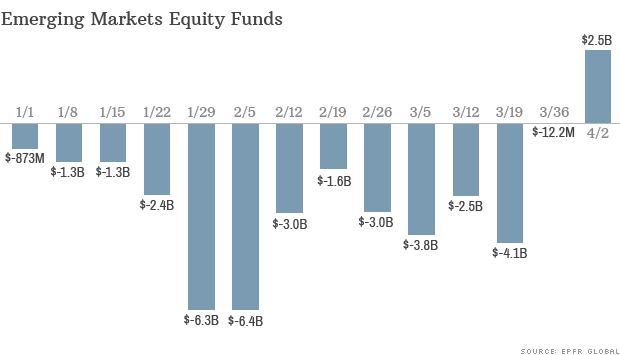
“Emerging is back”, although not as we know it, according to our guest today, BNP Paribas Investment Partners’ vice-chairman and LinkedIn influencer William De Vijlder. Having suffered more outflows in the first six weeks of 2014 than in the whole of 2013 on the back of crises in Turkey and Ukraine, as well as evidence of faltering growth in some of the world’s erstwhile superstar economies such as Brazil, emerging funds are pulling the cash back in. Emerging-market credit spreads are around their tightest in nearly a year, as a greater degree of confidence and stability return to some of these very volatile markets.

http://tinyurl.com/l3lsr5p

-Igor P Purlantov

Wednesday, April 23, 2014

Private Equity Shifts Gears In Emerging Markets

After surveying another year of disappointing results from their emerging market investments in 2013, many private equity (PE) investors that had enthusiastically piled into the big developing economies of Brazil, Russia, India and China (the BRICs) are rethinking their emerging market strategies.  As we discuss in Bain & Company’s 2014 Global Private Equity Report, the problem PE faces in emerging markets is stark: General partners (GPs) are failing to deliver on the job their limited partners (LPs) hire them to do—to generate market-beating returns. Indeed, returns of emerging market PE funds have been trending lower for nearly a decade. Even the best performers’ results have dropped steadily from their vintage peak.
-Igor P Purlantov

Tuesday, April 22, 2014

Emerging Markets in a "Sweet Spot"

Emerging markets get a nod this weekend from fundamental indexing guru and Research Affiliates CEO Rob Arnott for being “in the sweet spot” of long-term demographic change and short-term valuation. The comments come in colleague Lawrence C. Strauss’ interviewwith Arnott in the print edition of Barron’s.


http://tinyurl.com/m4ha5hn

-Igor P Purlantov

Monday, April 21, 2014

Versatility is Key to Emerging Markets

Investors who put money into emerging markets at the start of 2013 have had a miserable time. While shares in developed country markets forged ahead on continuing evidence of economic upturn, emerging markets went into reverse, on what is now a wearisomely familiar set of excuses: disappointment over macro-economic data, volatility (any remotely concerning turn of events world-wide is the trigger for sell-off) and capital repatriation to Western financial markets on expectations that interest rates are likely to rise sooner than expected.

http://tinyurl.com/l2grdzy

-Igor P Purlantov

Friday, April 18, 2014

A Low-Volatility Approach To Emerging Markets

iShares MSCI Emerging Markets Minimum Volatility (EEMV) is suitable for use as a small core holding in a diversified portfolio and is a solid alternative to a cap-weighted emerging-markets index fund. This fund tracks an index that selects about 200 stocks from its parent index (the MSCI Emerging Markets Index) to form a low-volatility portfolio. Low-volatility strategies seek to exploit the observed phenomenon that portfolios with smaller price fluctuations tend to outperform portfolios with larger price fluctuations over the long term.

http://tiny.cc/vgkiex

-Igor P Purlantov

Thursday, April 17, 2014

Emerging Markets Likely to Benefit Later in 2014

Emerging markets are likely to benefit later in the year from stronger growth in the United States and Europe despite the current cloud cast by slowing economic growth in China and geopolitical risks elsewhere, according to the April Global Macro Views report from Standish Mellon Asset Management Company LLC, the Boston-based fixed income manager for BNY Mellon.  "In the U.S., we are beginning to see tentative signs of a pickup in economic data following a harsh winter," said Thomas D. Higgins, chief economist and chief global strategist for Standish.  "In the euro zone, we have become slightly more optimistic given declining sovereign spreads in peripheral Europe and the possible freeing up of bank capital later this year after the European Central Bank's asset quality review."


-Igor P Purlantov

Wednesday, April 16, 2014

Emerging Markets: Separating The Sheep And The Goats


Investors who thought emerging markets were the bee’s knees have suffered agonizing reappraisals. After several years of Federal Reserve-fueled rallies, less developed markets are now in the doldrums. Emerging economies depend on exports for growth. That means Europe and North America. Unfortunately, as long as we are still deleveraging, the export-growth model is no longer viable.  For investors it’s important to separate well-managed emerging economies, the Sheep, from the poorly run economies, the Goats. My list of Sheep–South Korea, Malaysia, Taiwan and the Philippines–have current account surpluses, which measure the excess of domestic saving over domestic investment. So they are exporting that difference, which gives them the wherewithal to fund any outflows of hot money, as have occurred in the past year.

http://tinyurl.com/pjaop5g

-Igor P Purlantov

Tuesday, April 15, 2014

European QE Could Bost Emerging Markets

Although the US is winding down its own programme of QE, Monson doubts that that is the end of the story of central bank stimulus creating money that ends up in stock markets. ‘I think QE is here to stay and as a consequence this extraordinary bull run in real assets has some way left to run.’Yet rather than being driven by the US Federal Reserve, Monson supposes that the next phase of the rally could be spurred by the European Central Bank – especially with stubbornly low inflation in the continent and long-standing hawks such as Bundesbank president Jens Weidmann softening their tone. ‘It is highly likely the Europeans will be the next to embark on quantitative easing,’ Monson claimed.


http://tinyurl.com/k7fn8wj


-Igor P Purlantov

Monday, April 14, 2014

Investors Dip a Toe Back in Emerging Markets


Despite ongoing concerns about the Russia-Ukraine standoff and a Chinese slowdown, investors are dabbling in emerging markets once again.  Nearly $2.5 billion flowed into mutual funds and exchange-traded funds that invest in emerging market stocks during the week that ended April 2, according to data from EPFR Global.  It was the first time money poured into those funds since October.  The inflow suggests that investors have regained some appetite for emerging market stocks, which were trading at a sharp discount following a big sell-off in January. The iShares MSCI Emerging Market ETF, which tracks the widely-followed benchmark for emerging market stocks, is now in positive territory for the year.


http://tinyurl.com/o9bxbmf